
How Music Affects Your Productivity – Statistics
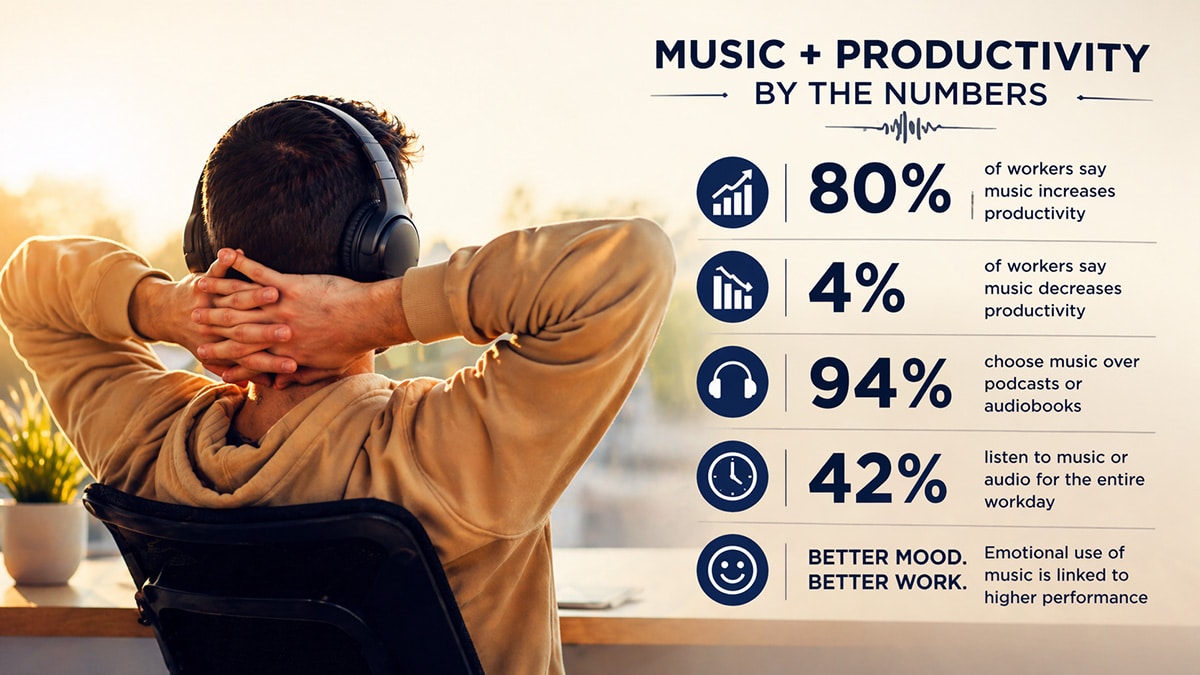
Music increases productivity for many workers. Around 80% of employees say it improves their performance, and 94% choose music over other audio while working.
The benefit depends on how music interacts with the task. Instrumental and steady music can improve focus, while music with lyrics or high intensity can disrupt concentration during complex work.
Key music and productivity statistics
- In a survey of 1,005 employees and employers, almost 80% of employed people said music increased their productivity[1]
- In the same survey, only around 4% said music decreased their productivity[1]
- 94% of employed people said they listen to music at work, compared with about 35% who listen to podcasts and 15% who listen to audiobooks[1]
- Around 42% of workers said they listen to some form of media for the entire workday[1]
- In a workplace study of 244 music-listening workers, emotional use of music was the only listening style directly linked to both higher job satisfaction and better self-rated performance[2]
- In a controlled cognitive task study, instrumental “workflow” music improved response speed and accuracy while also reducing anxiety after 10 minutes[4]
Does music increase productivity
Most evidence shows that music improves productivity for many workers, especially during routine tasks or when it supports focus and mood. Survey data and controlled studies point in the same direction, although the strength of the effect depends on how music is used.
| Finding | Result | Context |
|---|---|---|
| Workers reporting increased productivity | ~80%[1] | Self-reported workplace survey (n=1,005) |
| Workers reporting decreased productivity | ~4%[1] | Same survey |
| Music preferred over other audio | 94%[1] | Workplace listening habits |
| Faster and more accurate task performance | Improved performance[4] | Instrumental “workflow” music experiment |
| Job satisfaction and performance | Positive relationship[2] | Emotional use of music at work |
| Too much music reduces performance | Inverted U-shaped effect[6] | Extended listening reduces focus |
The main limitation is that many statistics are based on self-reported productivity rather than objective output. However, experimental studies showing faster and more accurate task performance suggest that music can produce real performance gains when used appropriately.
Match music to the task. Use instrumental music for focus-heavy work and more energetic music for routine tasks.
Avoid lyrics for thinking tasks. Words compete with reading and writing, reducing concentration.
Use music to improve mood. Listening for enjoyment or stress relief is linked to better performance.
Keep it steady and moderate. Loud or highly variable music is more distracting than consistent, low-intensity sound.
Don’t overdo it. Moderate listening helps, but too much can reduce focus over time.
Music and productivity statistics in the workplace

Workplace data shows a consistent pattern. In a survey of 1,005 employees and employers, almost 80% of employed people said music increased productivity, while only around 4% said it reduced productivity.
- About 42% of workers said they listen to some form of media for the entire workday
- Roughly 82% said they are allowed to listen to their own audio at work if they want
- Hospitality and retail were the sectors most likely to have music built into the workday, while education and scientific fields were the least likely
Despite the overall positive trend, some workers report distraction when music is too loud or poorly matched to the task. In the same survey, repeated playlists, disliked songs, and excessive volume were all identified as reasons music can reduce productivity for a minority of workers[1].
Related: How to Be More Productive at Work
How music affects mood and productivity
Music affects productivity through its impact on mood and mental state. In a workplace study of 244 employees who listen to music while working, emotional use of music, such as listening for enjoyment or emotional regulation, was linked to higher job satisfaction and better self-rated performance.
Emotional listening helps workers regulate how they feel during the workday. In the same study, emotional use of music had both a direct positive relationship with performance and an indirect one through higher job satisfaction.
Listening styles matter. Background use of music was not positively related to performance and showed a direct negative relationship with job satisfaction, suggesting that passive listening does not provide the same benefits as intentional use[2].
How music genres affect mood and productivity
Music genres influence productivity by shaping energy levels and emotional state. In the workplace survey, 31% of employed people identified classic rock as the most productivity-inducing genre, with alternative and pop ranking next.
For example, ambient, classical, and instrumental styles tend to support concentration because they create a steadier and less intrusive listening environment. By contrast, the same survey found that hip-hop and heavy metal were most often perceived as distracting genres at work.
Genre characteristics such as tempo, intensity, and lyrical content influence whether music supports or interferes with attention, which is why workers often find calm instrumental music more useful for demanding tasks[1] [3].
How music boosts productivity via brain and rhythm effects
Music increases productivity by activating reward systems in the brain. Research summarized in Forbes explains that preferred and familiar music can improve motivation, energy, and emotional engagement, which helps people sustain effort on tasks.
Familiar music is particularly effective because it reduces cognitive load. The brain does not need to process new patterns, allowing attention to remain on the task while still benefiting from the emotional lift the music provides.
- Familiar music helps reach a productive mental state faster
- Repetition strengthens emotional response and task engagement
- Steady beat supports consistent pace and effort
- Irregular or unpredictable sound patterns increase distraction
Rhythm plays a key role in performance. The same body of research summarized in Forbes argues that faster tempos and steady beats can improve motivation and endurance, while variable sound patterns are more distracting and can reduce efficiency[5].
Workflow music for focus and concentration

Certain types of music are more effective for productivity because they reduce distraction and support sustained attention. In a controlled study summarized by Georgetown, instrumental “workflow” music improved mood and cognitive performance during a demanding psychological task.
Participants listening to workflow music gave faster and more accurate responses, and the same study reported lower anxiety after 10 minutes of listening.
Music with lyrics introduces competing language input, which interferes with reading, writing, and problem-solving. The Georgetown summary notes that workflow music avoided lyrics and sudden melodic changes, which likely helped participants stay focused during complex tasks[4].
When music reduces productivity at work
Music reduces productivity when it competes with the task for attention, especially during complex or high-focus work.
- Lyrics interfere with reading and writing tasks
- Loud or intense music creates excessive mental stimulation
- Poorly matched music disrupts focus and task alignment
- Lower self-regulation increases susceptibility to distraction
Research in the Journal of Applied Psychology found an inverted U-shaped relationship between time spent listening to music and task performance, meaning moderate music exposure helped but too much reduced performance. The same research also found that people who believed their willpower was limited showed a stronger negative effect as music exposure increased[6].
Sources
- CloudCover – Music at Work Research
- PubMed Central – Music Listening and Workplace Outcomes
- LivingLoud – How Music Genres Affect Your Mind
- Georgetown University – Music and Productivity Study
- Forbes – Music Enhances Productivity
- Scott et al. (2025) – Too Much of a Good Thing? A Multilevel Examination of Listening to Music at Work
