
How Many Calories are Burned Doing Office Work?
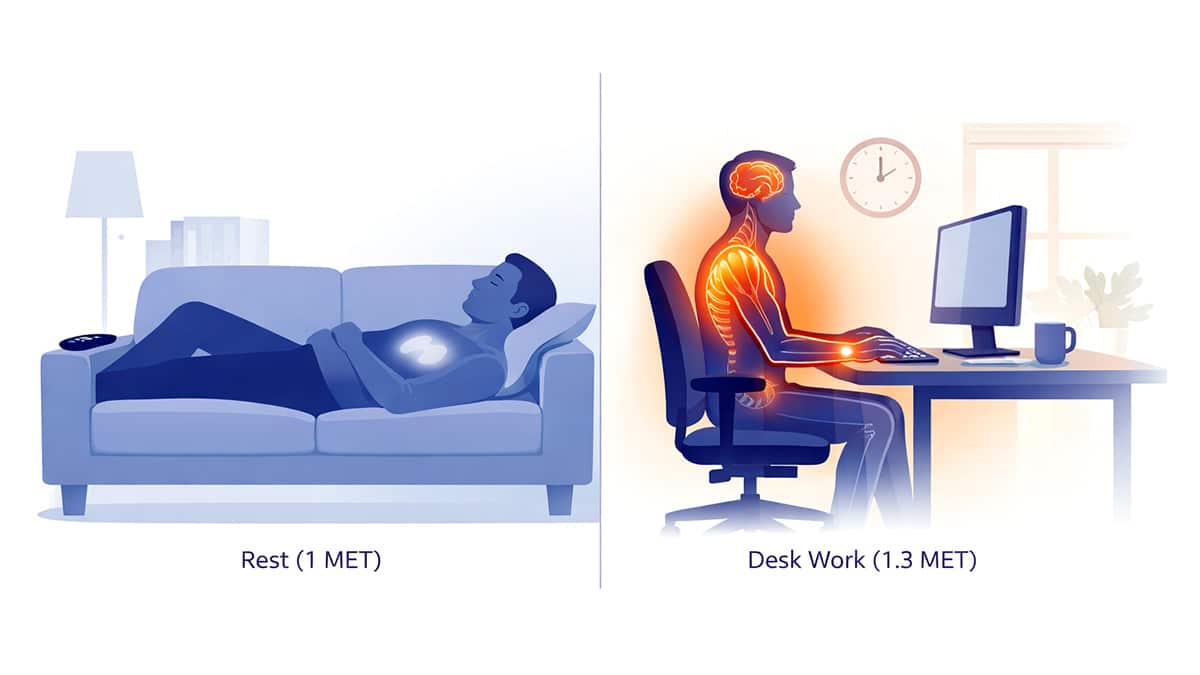
An 8-hour office workday burns about 780 to 940 calories for an average person weighing 75 kg, depending on how much time is spent walking or standing rather than sitting.
• Someone who remains seated almost the entire day burns roughly 780 calories.
• A typical worker who spends some time standing and walking burns around 860 calories.
• A very active office day with frequent movement can approach 940 calories.
Even desk jobs are not “doing nothing.” Sitting upright, typing, concentrating, and attending meetings all require energy, and small amounts of movement during the day add noticeably to total energy use.
Use the calculator below to estimate calories burned during your own workday.
How to Use this Calculator
1. Enter your workday hours.
Do not include commuting.
2. Enter your body weight (kg).
Pounds are shown automatically.
3. Add movement minutes (optional).
Standing tasks — talking, printing, coffee, moving around your desk area
Walking at work — moving around the building
Walking at breaks — lunch walks or going outside
4. Leave them at zero to estimate a fully seated desk day.
The result shows total calories burned during the workday and the active calories above resting metabolism. The line below the adjustments shows how much of your day remains seated.
Calories Burned Sitting at a Desk for 8 Hours
Researchers measure everyday activity using metabolic equivalents (METs). Complete rest is 1 MET. Desk work (typing, reading, writing, concentrating, and attending meetings) is about 1.3 MET, meaning it uses roughly 30% more energy than full rest.
Because the work is the same but bodies differ, calorie use rises with body weight. Larger people burn more calories performing the same seated tasks.
With no movement adjustments selected, the calculator estimates a fully sedentary workday.
A 75 kg person working 8 hours at a desk burns about 780 calories.
A 100 kg person burns about 1,040 calories.
These figures represent sitting for almost the entire workday, including meetings. Any walking or active tasks during the day add to this baseline. There is a Sitting at Desk Calories Burned Calculator showing the health costs of inactivity.
Does Standing at Work Burn More Calories?

Simply standing still — such as standing at a desk, waiting in a queue, or quietly observing — does not meaningfully increase energy use. According to the Compendium of Physical Activities, quiet standing has a similar energy cost to desk work, at about 1.3 MET.
Energy use rises when standing involves activity. Filing, making coffee, moving around the office, or performing tasks away from the chair requires more muscle engagement and increases energy expenditure.
Active standing tasks are estimated at roughly 1.8 MET, which is about 80% higher than full rest and about 40% higher than seated desk work. This is why even short periods away from the chair noticeably increase total calories burned during the workday.
How We Calculate Calories Burned Per Day
The calculator is based on the Compendium of Physical Activities, a research reference used in exercise physiology and public-health studies. Each activity is assigned a metabolic equivalent (MET), where 1 MET represents complete rest.
We apply the standard metabolic equation:
Calories = MET × body weight (kg) × time (hours)
Desk work is treated as 1.3 MET, with higher MET values applied to standing tasks and walking. The calculator separates the workday into seated time and movement time, then sums the energy cost of each period.
For a typical office day we include an indicative 50 minutes of movement, but this varies widely depending on the job, workplace layout, and personal habits. You can adjust the activity minutes to match your own day.

Interesting. I notice that some people move around a lot, talking and chatting throughout the day. Others look like they’re chained to their desk. The calculator shows this has an impact but, it’s really not that much compared to serious exercise.